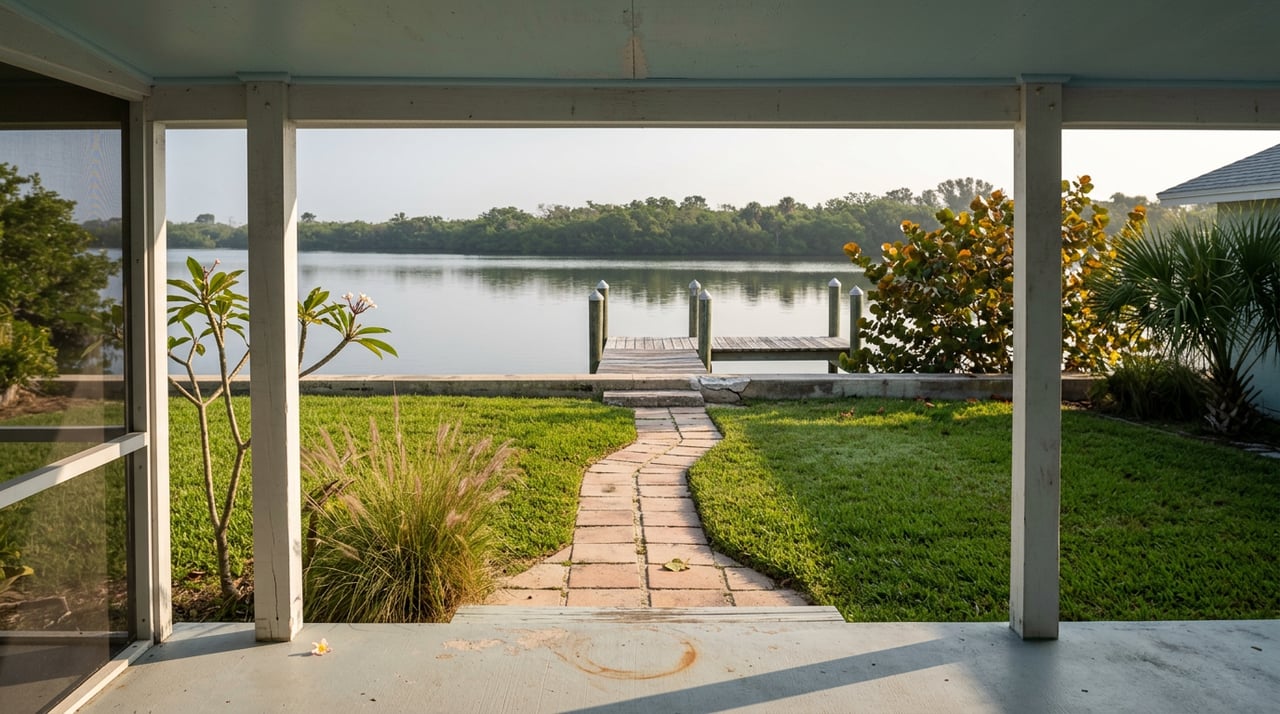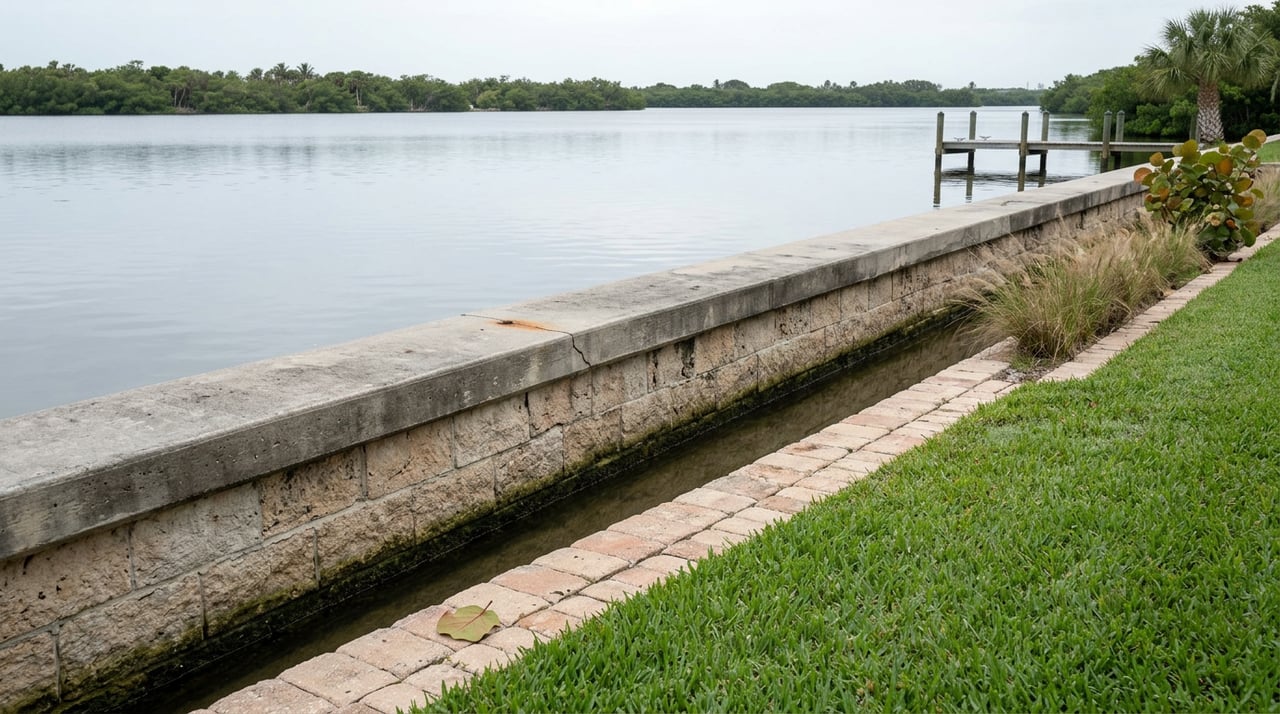
Most Snell Isle showings follow the same rhythm. The agent opens the sliding doors, the buyer walks past the pool toward the water, and the conversation turns to the dock, the boat lift, the view down the canal toward Tampa Bay. Almost nobody stops to look at the wall holding the yard in place.
That's a mistake worth correcting before you write an offer or sign a listing agreement, because the City of St. Petersburg has now completed one of the most detailed inspections of its own seawalls to date, and the results say something uncomfortable about the walls nobody inspected: the ones sitting in front of nearly every home on this island.
Almost Every Wall on Snell Isle Belongs to the Homeowner
Here's the number that reframes the whole question. St. Petersburg has roughly 80,000 linear feet of city-owned seawall and roughly 500,000 linear feet of privately-owned seawall. The city's wall is the exception. The homeowner's wall is the rule.
Snell Isle is where that rule matters most. Local builders who work the island routinely describe seawall evaluation as a required first step before any waterfront design begins, because most waterfront lots along Brightwaters Boulevard, Coffee Pot Bayou, and Smacks Bayou carry a seawall the owner is solely responsible for maintaining, repairing, and permitting. The city doesn't inspect it on a schedule. The city doesn't fund its repair. If it cracks, leans, or lets soil wash out behind it, that's a private capital project, not a municipal one.
Which is exactly why the city's newest data is worth paying attention to, even though it technically describes a different set of walls.
What the City Found When It Finally Looked
In February 2026, St. Petersburg held two public hearings on its Strategic Seawall Capital Improvement Plan, a comprehensive engineering assessment of the city's own shoreline infrastructure. Cummins Cederberg Coastal & Marine Engineering inspected roughly 81,000 linear feet of city-owned seawall and rated the condition of each section against American Society of Civil Engineers standards. The result: roughly 53 percent of the city's inspected seawalls came back rated Poor or worse.
That's the public infrastructure, the wall the city built, tracks, and funds through capital budgets and grants like the Community Development Block Grant that helped pay for this assessment. If half of the walls the city actually monitors are already in poor shape, it's a reasonable question to ask what condition the other 500,000 linear feet are in, the walls nobody schedules an inspection for unless a homeowner pays for one.
City engineers are already treating the Snell Isle area as a priority stretch. A separate capital project put $1.6 million into seawall infrastructure tied specifically to the 31st Avenue NE bridge on Snell Isle, a signal that the city recognizes this shoreline as consequential enough to fund directly. During the February hearings, city engineer Prayman described the technical bind that makes many of these repairs slower than homeowners expect:
"We are reviewing the hydraulic capacity of it to see how best to replace the walls but not impact the ability for it to convey stormwater."
That same engineering complexity, matching a new wall's height and drainage function to the water it's actually managing, applies just as much to a private canal wall behind a Snell Isle home as it does to a public one. It's one reason these projects rarely move as fast as a homeowner hopes.
What Repair or Replacement Actually Costs
If an inspection or a disclosure conversation turns up a problem, the price range is wide, and where a given wall falls in that range depends on material, height, and how much of the structure has already failed.
| Scope of work | Typical cost, per linear foot (Pinellas County, 2026) |
|---|---|
| Crack sealing, minor cap repair | $100 – $250 |
| Full replacement, vinyl or steel | $150 – $450 |
| Full replacement, concrete or high-erosion site | $350 – $600, sometimes higher |
| Engineering design and permit fees | $2,000 – $3,000 flat, plus permit costs |
A 75-foot canal wall needing full replacement can run anywhere from roughly $11,000 to $45,000 before engineering and permit costs, and a Brightwaters or open-bay lot with more exposure to wave action tends to land at the higher end of that range.
The Timeline Is the Part That Surprises People
The dollar figure is rarely what derails a Snell Isle transaction. The calendar is.
Seawall contractors across Pinellas County are booked out well in advance, and industry guidance for the county now suggests reaching out six to nine months before you actually want work to start, simply to get on a schedule. Permit review has stretched too. Reviews now include stricter environmental checks, particularly near mangrove areas in St. Petersburg, and those extra steps add weeks before a permit is even issued, on top of the review itself.
Put those two delays together and a homeowner who discovers a failing wall in January might not see a contractor start work until the following winter. For a seller, that timeline can outlast the deal itself. For a buyer, it's a real cost to factor into your offer, not a problem you can assume gets solved before you move in.
The Paperwork Follows the Wall, Not the Other Way Around
Florida law puts the burden of disclosure on the seller, not the buyer. Under the doctrine established in Johnson v. Davis, a seller who knows about a material defect that a buyer wouldn't discover through a normal walkthrough has to disclose it, and an "as-is" contract does not erase that obligation. The standard Florida Realtors disclosure form asks directly whether the seller knows of any past or present problems with seawalls due to drainage, flooding, or soil movement. If the answer is yes, it has to be explained on the form, not left for the buyer to find out during inspection.
Two more layers apply specifically to coastal property. Florida's flood disclosure statute, in effect since October 2024, requires sellers of residential property to complete and deliver a flood disclosure at or before the buyer signs the contract. Separately, Florida law requires a written statement about the potential for erosion on coastal property, along with a note that the property may be subject to construction restrictions tied to coastal protection.
None of this means a seawall issue kills a sale. Sellers who document what's known, what's been repaired, and what hasn't tend to negotiate from a stronger position than ones who stay quiet and hope an inspector misses it. Buyers who ask for that documentation early, rather than after their own inspection turns something up, keep more leverage and more time.
One more wrinkle worth knowing if you're planning to renovate rather than just buy: Florida's 50 percent substantial improvement rule, which can force a home up to current flood elevation once renovation costs cross half the structure's depreciated value, technically excludes the seawall itself from that calculation. But if a failing wall lets water undermine the foundation behind it, the resulting structural repair does count toward that threshold. A seawall problem and a substantial-improvement problem can arrive on the same lot at the same time.
What This Means Depending on Which Side of the Table You're On
If you're selling a Snell Isle waterfront home, get ahead of the question rather than waiting for a buyer's inspector to raise it. A recent engineering assessment, even an informal visual one, gives you documentation to point to and a repair-or-price-accordingly decision to make on your own timeline instead of the buyer's.
If you're buying, ask who owns the wall, when it was last inspected, and whether any repairs are documented, before you're deep into a due diligence period with a clock running. St. Petersburg's own GIS resources include a shoreline viewer that lets residents check ownership and condition information by area, a useful first stop before you ever call a marine contractor.
A Few Questions Worth Asking Directly
Does a seller have to tell me if the seawall has known problems? Yes. Florida's disclosure duty under Johnson v. Davis covers material defects the seller knows about and a buyer wouldn't reasonably discover on a walkthrough, and the standard disclosure form asks about seawall problems directly.
Will homeowners insurance pay to fix a failing seawall? It depends on the cause. Sudden storm damage is more likely to be covered under a standard policy. Gradual deterioration from age, tidal wear, or soil movement over time typically is not.
How long should I budget if a wall needs work after closing? Plan for months, not weeks. Contractors in Pinellas County are commonly booked six to nine months out, and stricter environmental review for waterfront permits adds further weeks on top of the physical work itself.
Every waterfront lot on this island has its own history with the water in front of it. Some walls were rebuilt recently. Others have never been touched. The only way to know which one you're buying or selling is to ask before it becomes a surprise at inspection. If you'd like a second set of eyes on a specific Snell Isle address, or want to talk through what a seawall condition might mean for your timeline or your price, Deanna Huber is glad to help. Let's Connect.